The U.S. banking industry closed 2025 with a strong full‑year performance—higher assets, earnings, margins, and deposits—yet the fourth quarter data revealed soft spots, including weaker income, rising problem‑loan categories, and a growing reliance on uninsured deposits.
Community banks outperformed the broader industry with faster asset and loan growth, stronger earnings, and wider margins, though increases in OREO and commercial real estate exposure point to emerging risks.
Industry consolidation continued, with a net loss of 43 banks in Q4, and the number of troubled and problematic banks on Bauer's report matches the FDIC’s Problem List at 60.
Jumbo Rate News JRN 43:09
All New Bank Star-Ratings Now Available
All bank star-ratings have now been updated based on fourth quarter 2025 financial data. FDIC Chairman, Travis Hill was quite upbeat when introducing the results, and with good reason. All of the following categories showed improvement over 2024.
Assets:
Total assets increased by $144.7 billion (0.6%). The increase in assets was led by loan demand. Overall fourth quarter loan growth was up 2% from the third quarter and 5.9% from year-end 2024. Credit card balances were among the most in-demand loans along with loans to non-depository financial institutions (e.g. fintechs).
Income:
Banks reported full year net income of $295.6 billion. That’s a 10.2% increase from 2024. Similarly, the return on average assets (ROA) was up from 1.12% in 2024 to 1.20% in 2025.
Net Interest Margin:
The industry aggregate net interest margin (NIM) increased to 3.39% in the fourth quarter. That brought its NIM for the full year to 3.30%. The industry NIM was 9 basis points higher than in 2024 and is at its highest level since 2019.
Deposits:
Total deposits increased 4.5% over 2024 with domestic bank deposits up 1.8% in the fourth quarter, marking the sixth consecutive quarter of deposit increases.
That is all good news. Now let’s take a look at what wasn’t mentioned.
Assets:
The FDIC reports asset quality as “generally favorable”. It then goes on to report that past due and nonaccrual rates for non-owner occupied commercial real estate (CRE), multifamily CRE, auto loans and credit cards are all well above their pre-pandemic averages.
Income:
The quarterly net income was down $1.6 billion (2.0%) in Q4’2025. While the decreased income was blamed on noninterest expense along with non-recurring expenses at several large banks, it is interesting that more than 60% of all banks reported lower income in the fourth quarter than in Q3’2025.
Net Interest Margin:
The industry NIM is up and there is no dispute about that. As CD investors, however, you should understand that the reason it is up is that the cost of funds (the rate on CDs and other savings accounts) is falling more rapidly than the rates the banks are yielding on loans and other earning assets.
Deposits:
Total deposits are rising, but so are uninsured deposits. Estimated uninsured domestic deposits rose 2.7% in the fourth quarter. Only the largest banks estimate uninsured deposits, yet that was the driver of the overall 1.8% increase in domestic deposits.
Now let’s take the big banks out of the equation and take a look at how our community banks fared.
Assets:
Total assets at community banks increased 1.5% during the fourth quarter and 5% during calendar 2025. Loans led the charge with a quarterly increase of 1.4% and an annual jump of 5.4%.
Nonfarm nonresidential CRE loans took the lead with a 1.9% increase in the fourth quarter and a 6.9% annual increase. Single family residential property and commercial and industrial (C&I) loans also contributed to the year over year growth.
Home equity lines occupy a fairly small piece of the asset pie, but increased 15.2% over the year. Another small but growing niche is other real estate owned (OREO) which is property generally acquired via repossession. Community bank OREO increased 40.7% over the year.
Income & NIM:
2025 net income at the 3,909 community banks was up 22.5% over 2024. That, in spite of a 3.8% fourth quarter decrease. Community bank ROA of 1.11% is the highest it has been since 2022.
Full year net operating income of $30.287 billion was 21.8% higher than 2024.
The community bank NIM widened 33 basis points over the course of the year. This was due to an increase of 9 basis points on average earning asset yields and a drop of 23 basis points on funding costs (i.e. CD rates and the like).
Deposits:
Domestic deposits rose 5% at community banks over the last four quarters. In the fourth quarter alone, interest-bearing deposits increased 1.6% and noninterest-bearing deposits were up 1.1%.
In Conclusion:
The number of U.S. banks continues to shrink. During the fourth quarter: one new bank opened (3½-Star Solutions Plus Bank, Albertville, AL (59362)); 4 community banks were bought by credit unions; two community banks liquidated voluntarily; and 36 merged or consolidated with other banks (32 community banks and 4 non-community banks). That’s a net loss of 43.
And, perhaps for the first time ever, Bauer’s Troubled and Problematic Bank Report contains the same number of banks as the FDIC’s Problem List (60).
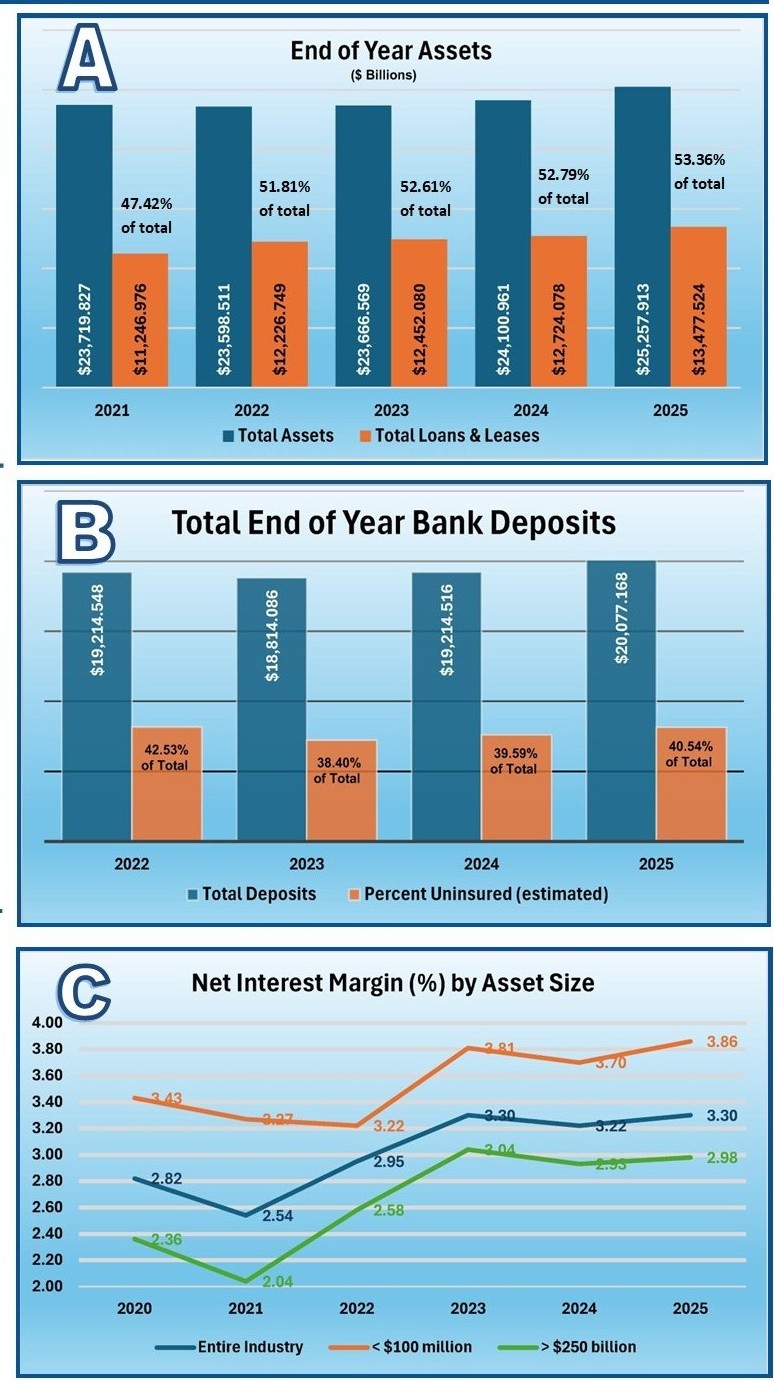
A. Loans: The single largest component of a bank’s assets. Graph A depicts the relationship between loans and total assets for the past five years.
What we see is a moderate increase in total assets, with faster paced growth in the loan department.
________________________________________
B. Deposits at U.S. banks are well above their pre-pandemic level, rising 4.5% between year-end 2022 and year-end 2025.
In the fourth quarter 2025 alone, estimated uninsured domestic deposits rose 2.7%.
________________________________________
C. NIM: The industry’s net interest margin (NIM) of 3.30% is also on the rise (up from 3.22% a year earlier and just 2.95% at the end of 2022. Big Banks can afford to have a smaller NIM (and they do) whereas the smallest bank cannot rely on scale. The smallest banks have the highest NIMs.
________________________________________