

All bank star-rating have now been updated based on June 30, 2026 financial data; we expect credit union star ratings will be available sometime after Labor Day.
In the meantime, we encourage you to check the ratings of any banks on which you have deposits or are considering placing deposits at bauerfinancial.com.
JRN by Bauer 43:33
All New Bank Star Ratings Released Today
All bank star-rating have now been updated based on June 30, 2026 financial data; we expect credit union star ratings will be available sometime after Labor Day. In the meantime, we encourage you to check the ratings of any banks on which you have deposits or are considering placing deposits at bauerfinancial.com.
A lot of things went right for the banking industry this quarter. Net income was up 12% from the first quarter and 28.7% from a year ago. The increase was attributed to two primary things: higher trading revenue and better interest margins.
We will get more into loan quality next week, but provisions for loan losses were down (10% from first quarter and 35% from a year ago). That certainly helped, as did a decrease in employee salaries and benefits expenses.
Loans increased 1.8% during the second quarter with the largest increase in “loans to nondepository financial institutions” (eg. private equity firms and fintechs), which were up 3.4% in the quarter and 22.4% over the year. Total loans increased 1.8% and 6.8%, respectively. Other loan types can be found in the chart (below).
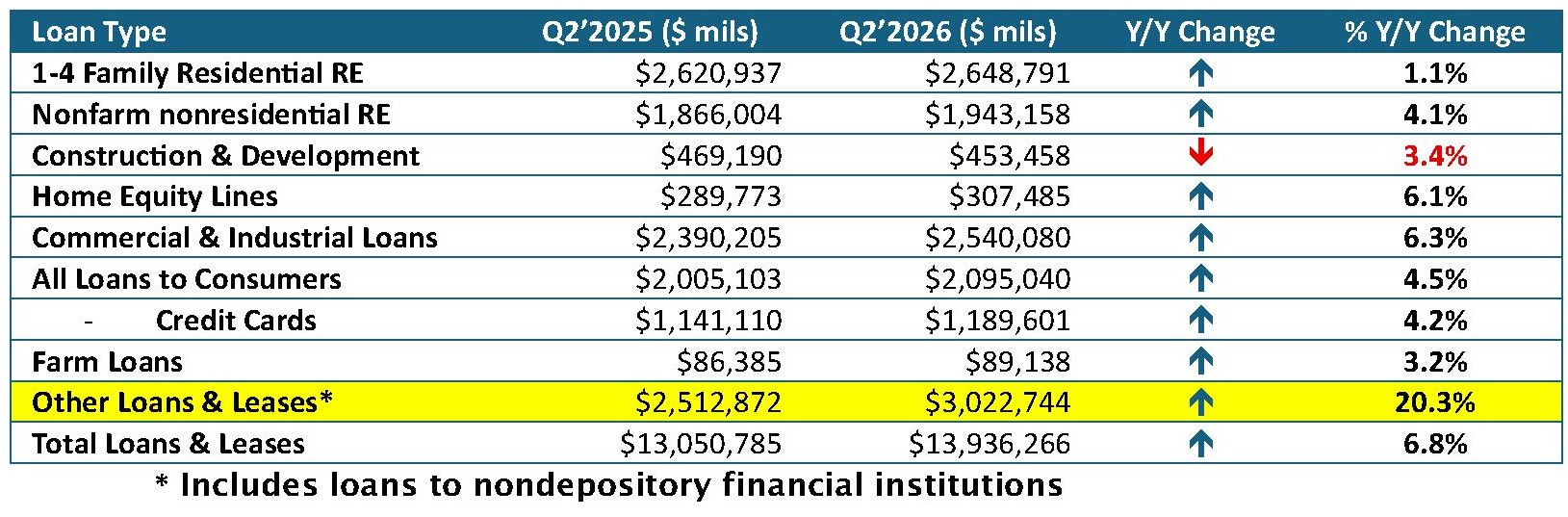
Loan growth is typically a positive development as it reflects growth in the overall economy. However, if not properly underwritten, too much loan growth can lead to problems down the road.
What we really want to discuss is the rise in deposits, more precisely, the rise in estimated uninsured deposits. During the twelve months ending June 30, 2026 domestic bank deposits increased roughly 5½%. Estimated uninsured deposits were up more than 10% in that timeframe, and not just at the Big Banks.
In the second quarter alone, community banks reported an increase in domestic deposits of $9.2 billion (0.4%). Of that, only $970.8 million is estimated to be insured. That adds a new $8.3 billion to the estimated uninsured deposits.
Estimated uninsured deposits at all U.S. banks now exceed $8.4 trillion.
To be fair, the industry is in quite good shape right now, with only 1.1% of U.S. banks earning a place on either the FDIC’s “Problem Bank List” or Bauer’s Troubled and Problematic Bank Report. All banks rated 2-Stars or below can be found on Bauer’s report. (The FDIC’s list is not publicly available.)
Another thing to be aware of is that both the industry’s leverage capital ratio (CR) and tier 1 risk-based CR dropped by 17 basis points from the first quarter. The Aggregate Leverage CR is now below 9% (8.98%). Again, this isn’t a concern now but has the potential to be if it continues to drop. Bauer will have its eyes on these things going forward (so you don’t have to).