
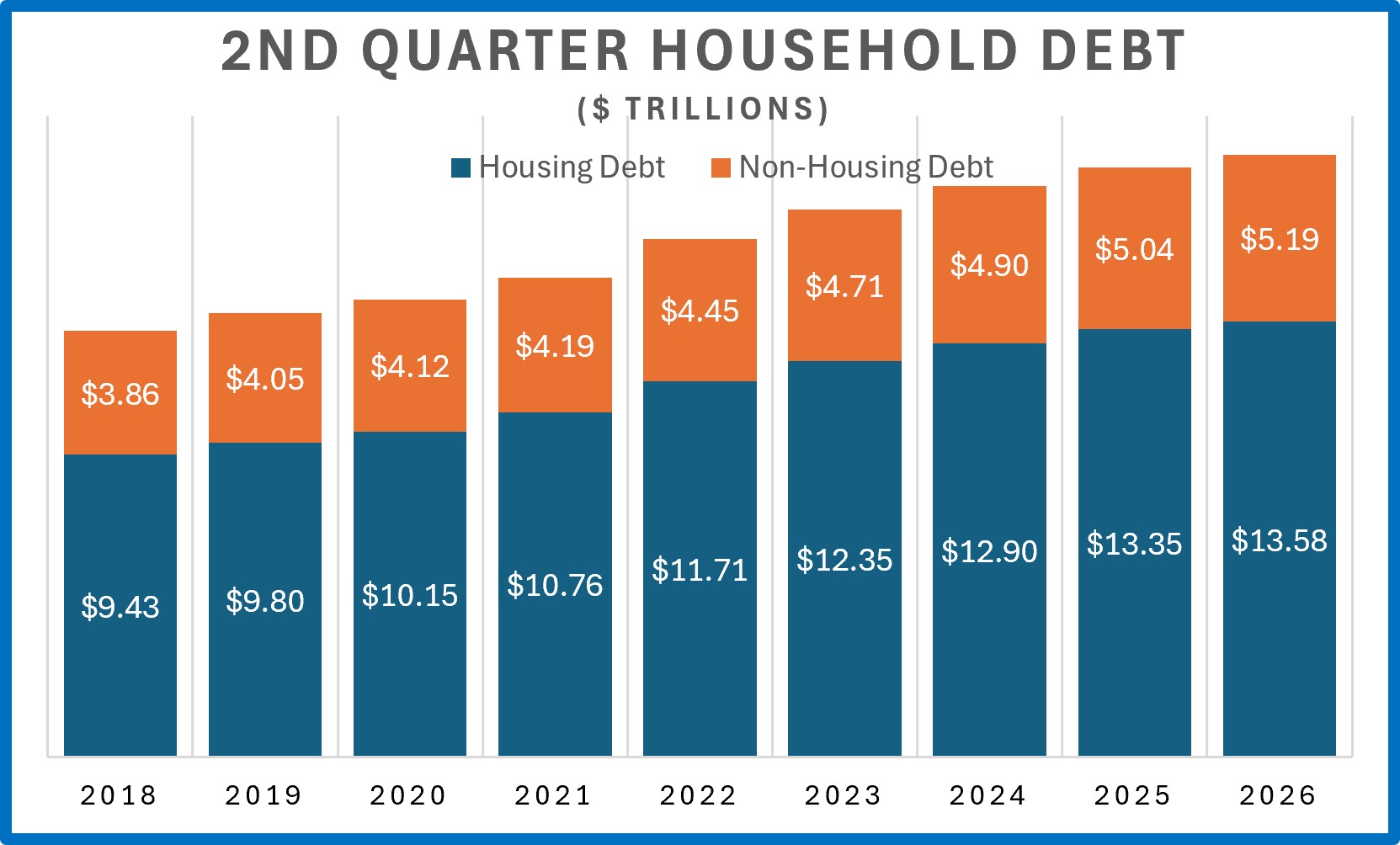
U.S. household debt has risen more than 40% since 2018, driven largely by mortgage and home equity borrowing, while credit card and auto loan balances continue to climb.
While the banking industry asset quality remains relatively stable, the recent failure of Tioga-Franklin Savings Bank (the fifth bank closure of 2026) highlights how poor loan quality, persistent losses, and inadequate capital can lead to an untimely ending.
While only a handful of banks currently fall into the "significantly undercapitalized" category, rising consumer debt levels and growing financial stress among borrowers could create additional challenges for vulnerable community banks.
JRN by Bauer 43:34
Household Debt Climbs 40% Since 2018
The U.S. national debt outstanding recently surpassed $40 trillion in what the Wall Street Journal referred to as an “unsustainable fiscal trajectory”. Debt is nothing new to this country. In fact, the U.S. has carried a national debt, with few exceptions, since the Revolutionary War. The national debt exceeded $75 million by 1791 (that would be about $2.7 billion today).
More important than the sheer amount of debt, however, is the ability of a borrower to pay it down. That is the same regardless of what type of borrower it is. (A person earning $100,000 per year can afford much more debt than one making $50,000 but much less than one earning $250,000.) And while there are people in this country who do not incur debt, they are the exception, not the rule.
Consumers have little control over the national debt but, generally speaking, want to be in control their own debt, which according to recent headlines, is burgeoning. “Auto loan delinquencies near 23-year high”, according to one headline; “Personal bankruptcy filings are soaring in 2026”, says another. They certainly grabbed our attention.
Fortunately, the Federal Reserve Bank of New York recently released its Second Quarter 2026 Quarterly Report on Household Debt and Credit. The report shows that U.S. household debt climbed more than 40% between June 30, 2018, and June 30, 2026. Housing-related debt, shown in blue in the graph below and including home equity lines of credit (HELOCs), increased 44% over the same period. HELOC balances alone grew by $13 billion during the second quarter of 2026, marking the 17th consecutive quarter of growth and bringing total outstanding balances to $459 billion.
Non-housing debt (credit cards, auto loans, student loans & other) grew by $48 billion, or 0.9% in the second quarter of this year, but nearly 24% in the past 5 years. Auto loan and credit card balances led the charge, each growing 1.7% in the latest quarter alone. (We won’t get into the student loan debt fray.)
What happens when consumers take out too much debt? Bankruptcies and foreclosures often follow. Roughly 137,000 consumers had new bankruptcy notations added to their credit reports in the second quarter while 55,000 saw new foreclosures.
Now, the $64,000 question: How will all of this affect our banks? As if on cue, another small, community bank failed on Friday, August 21, 2026. This was not just another bank failure. This was a 153-year-old Black-Owned Minority Depository Institution (MDI) in the heart of Philadelphia. This was Zero-star Tioga-Franklin Savings Bank (33802) which was also among a number of MDIs featured in Essence Magazine last year honoring black-owned banks and credit unions for keeping local dollars circulating within the communities they serve.
5-Star Second Federal Savings & Loan of Philadelphia (29627) assumed most assets and all ($67 million) deposits of the failed Tioga-Franklin. Tioga-Franklin was significantly undercapitalized when it filed its March reports and its June capital ratios (Leverage CR of 2.06%) were even worse. We were surprised by the fact that the acquiring bank, Second Federal, is not an MDI. It is however a community bank, and a mutual savings association at that.
Second Federal is a $46 million asset community bank serving central Philadelphia. With this transaction, it will more than double both its assets and deposits and will double its footprint (from 1 to 2 branch offices). But how did Tioga-Franklin find itself in this position?
Two words: soured loans. This trendy Fishtown neighborhood of Philly, the home of Tioga-Franklin, was formerly considered part of Kensington, a historic, working-class neighborhood that has seen more than its share of job losses. While the city is working on turning things around, the delinquent loans at Tioga-Franklin were already too far gone.
By March 31, 2026, Tioga-Franklin SB had a Bauer’s Adjusted capital ratio of -0.64% and by June 30th that was down to -2.96%. Similarly, its Texas Ratio of 83.9% at March 31st burgeoned to 166.2% by June 30th. (Reminder: the Texas Ratio indicates that a bank is much more likely to close (or be closed) as the ratio approaches 100%.) To make matters worse, Tioga-Franklin had less than 25% of its delinquent loan amount set aside to cover loan losses. The bank was clearly struggling to make ends meet; it only posted one quarterly profit in the past three years. Its capital declined 67% between June 30, 2025 and June 30, 2026.
We are sorry to see this historic bank reach the end of its line and a bit saddened that it was purchased by a non-MDI. Until its closure, Tioga-Franklin had been the oldest FDIC-insured Black or African-American owned bank operating in the USA. In July we wrote, “It (Tioga-Franklin) has had its ups and downs in the past and has always managed to pull through. After 153 years, we certainly hope with the support of the Philadelphia community, it can continue to do so” (JRN 43:26).
As for Second Federal, it is gaining a more advanced processing system than what it had, allowing it to “offer a more contemporary range of banking services and products to all of its customers.” And, since Second Federal is a mutual savings association, all Tioga-Franklin depositors are now part owners of the combined institution.
Tioga-Franklin’s failure marked the fifth of 2026. That’s the most we’ve seen since 2023. (If there are any more, it will be the most since 2017.) There were no “Critically Undercapitalized” banks based on the June data; those, had there been any, would require prompt corrective action (PCA). There are three other “Significantly Undercapitalized” banks. They are: Zero-Star Lamont Bank of St. John, WA (8681); Zero-Star Old Glory Bank, Elmore City, OK (18924); and Zero-Star Summit National Bank, Hulett, WY (25054).
All can be found on Bauer’s Troubled and Problematic Bank Report along with all other banks rated 2-Stars or below. Combined, these three banks have less than $400 million in assets and operate through just five branch offices. That’s not much when compared to the overall industry, which has total assets exceeding $26 trillion.
The banking industry reported fewer “90 days or more delinquent plus nonaccrual” as well as “short-term, 30-89 days past due” loans as of June 30, 2026 than it had at the end of both the first quarter 2026 and the end of 2025. We are hoping it stays that way and that we are seeing the beginning of a new trend of lower problem loans, but we remain watchful as always, particularly given the growth in consumer debt (see chart above).