Since the beginning (250 years ago), the United States has seen banks come and go. It was not until the late 1800s, however, that marginalized minority communities began pooling their money together to open their own banks.
Today we celebrate Maggie L. Walker, an African-American, who was the first woman to ever open a bank in this country. Maggie and her bank are both long gone now, but her legend remains.
What Maggie, and other pioneers like her knew was that, without financial freedom, no one is ever truly free.
JRN by Bauer 43:26
FDIC-Insured Minority Depository Institutions, Helping Their Communities Prosper
For the better part of 40 years, (since the passage of the Financial Institution Reform, Recovery and Enforcement Act of 1989 (FIRREA)), federal regulators have been tasked with building up our nation’s minority depository institutions (MDIs). Black owned banks were hit especially hard during the savings and loan crisis. At their peak in the 1970s, we reportedly had 50 black owned banks operating in the United States but lost 35 by 1988. This story is about those that thrived.
Five score and three years ago, Maggie Lena Walker became the first women in the U.S. to found and charter a bank. Maggie Walker was an African American woman with ambition, determination and the desire to help her neighbors and friends. Her bank, the St. Luke Penny Savings Bank, Richmond, VA opened in late 1903 as the fourth Black Owned bank in Richmond.
On its first day, the bank took in $8,000 from about 300 customers. By 1920, St. Luke Penny Savings Bank’s assets had grown to $530,000 and it had financed more than 600 homes in the predominantly black part of town. The bank survived by adapting to its customers’ needs. By 1924, it was reported that at least 600 of the bank’s customers had paid off their mortgages in full.
To survive the Great Depression, Walker merged her bank with two other Black-owned banks to become Consolidated Bank & Trust. She served as Chairman of the board at Consolidated Bank until her death in 1934 at the age of 70. Consolidated Bank & Trust continued for another 70 years. In 2005, over a century later, Consolidated merged into Abigail Adams National Bank, a woman-owned, but not black-owned, bank in Washington, DC.
In the years since, there have been many changes in ownership. The original Consolidated Bank office at 398 N 1st Street in Richmond is now a branch of 5-Star Peoples Bank, Marietta, OH (6544) which is not an MDI, although it does showcase a tribute to both Maggie Walker and Consolidated Bank by the front entrance. Maggie Walker’s home is now a National Historic Site, and a 10-foot statue of this larger-than-life woman stands in The Maggie L. Walker Memorial Plaza. Both are also in Richmond.
While Maggie Walker and her bank are long gone, there are 24 other FDIC-insured Black or African-American owned banks operating in the USA today. The oldest, Zero-Stars Tioga-Franklin Savings Bank (TFSB), Philadelphia, PA (33802), was established in 1873 as Tioga Building & Loan Association. TFSB has had its ups and downs in the past and has always managed to pull through. After 153 years, we certainly hope with the support of the Philadelphia community, it can continue to do so.
5-Star Liberty Bank & Trust Company, New Orleans, LA (20856) is not the oldest Black or African-American owned bank but it is among the largest. Established in 1972, Liberty B&TC has over $1.1 billion in assets and employs almost 200 locals. Its goal: “We work hard. Play hard. Invest where our heart lives. And pursue freedom for all”. That seems like the perfect place to finish this article, but a new MDI came on the scenes this year, and we’d like to introduce you.
On February 9, 2026, 3½-Star Generations Community Bank, Indianapolis, IN (59365) became the first MDI headquartered in the Hoosier State. Generations Community Bank is what’s called a multi-racial American MDI, and, as has been becoming more common, refers to itself as a Mission Driven Institution MDI, rather than minority depository institution. It is in fact both.
President and CEO of Generations Community Bank, Al London has a mission for all residents and all businesses that have historically had trouble gaining access to banks.
“That mission is to facilitate economic mobility, economic growth to all members of our community, with special attention to those that are historically being underserved and under-banked by traditional banks. Ultimately, we want to build wealth in these communities for generations to come.”
That sounds a lot like Maggie Walker, doesn’t it?
For stock institutions, FIRREA defines a Minority Depository Institution as: a federally insured depository institution where 51% or more of the voting stock is owned by U.S. citizens or permanent residents who are Black or African-America, Asian American, Hispanic American, or Native American.
For non-stock institutions, a majority of the board of directors, account holders and the community served must be predominantly one or more of the above minority groups.
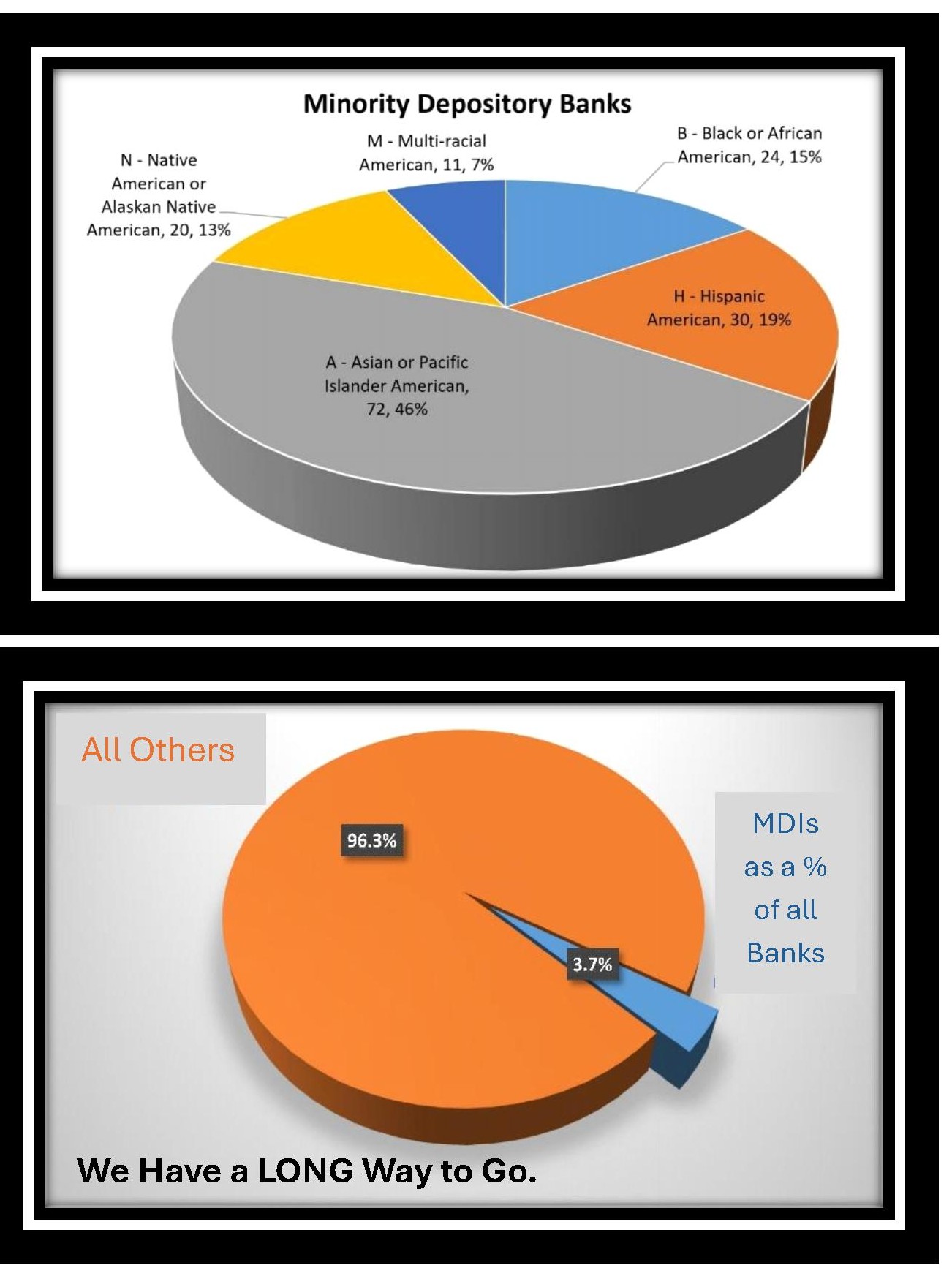
Here’s where the banking industry stood at March 31, 2026:
|
Minority Designation |
Number of Banks | Percent of MDIs |
| Black or African-American |
24 |
15.3% |
| Asian American |
72 |
45.9% |
| Hispanic American |
30 |
19.1% |
| Native American |
20 |
12.7% |
| Multi-racial American |
11 |
7.0% |
| Total as of 3/31/2026 |
157 |
100% |
A spreadsheet of all 157 FDIC-insured MDIs as of March 31, 2026, along with financial highlights is available for immediate download. The list is broken down by minority group, then listed alphabetically by headquarter state. If the bank operates in other states, those states are noted as well. Download is just $35.