
As Fed Chair Kevin Warsh announced it would leave its benchmark interest rate unchanged at 3.75%-4.0%, he reiterated his commitment to bringing inflation back to 2% and suggested that the Fed's restrictive monetary policy is beginning to have the desired effect.
The economy remains surprisingly strong and inflation is gradually moderating, so the Fed appears inclined to pause for now while keeping the option of future rate increases on the table.
Plus, we tip our hats to the Brewers.
JRN by Bauer 43:43, November 4, 2026
Interrogating Reality: The Fed’s Wait-and-See Approach
Overall inflation was up 3.7% in September, but when volatile food and energy prices are removed from the equation, CORE inflation was actually up much less (2.6%). Inflation has been stubbornly resting above its 2% target for 5½ years (since April 2021) and peaked in 2022. Exactly what month it peaked depends on which measure of inflation you use (see chart below).
The Consumer Price Index (CPI) and the Personal Consumption Expenditures Index (PCE) are two common measures of inflation – both measuring how prices change over time. The PCE contains a larger “basket of goods” in its index than the CPI. The PCE also includes spending made by, as well as on behalf of, consumers whereas the CPI only includes out-of-pocket expenditures by urban households. For these reasons, the PCE is both more encompassing and less volatile than the CPI.
It is no wonder the PCE is the preferred inflation measure of the Fed. According to data from the Federal Reserve Bank of Cleveland, the CPI last peaked in June 2022 at 9.06%. The PCE peaked three months later (September 2022) at 6.69%.
We all know about inflation, we feel it every day at the grocery store and the gas pump. Yet the general consensus (aside from two descending) at the Fed’s Open Market Committee Meeting (FOMC) was that there should be no change in rates at this meeting. And there was not. Perhaps not for the reasons people expected, but the Fed’s benchmark rate remained unchanged at between 3.75-4%.
In his comments at the conclusion of the 2-day meeting, Chair Warsh insisted that the midterms played no part in the committee’s decision. When asked if we could expect another quarter point bump in December, Mr. Warsh declined to comment, insisting if any forward guidance was going to be verbalized, it would not be by him.
We get that. He has already made it clear that he does not want to influence the markets by making predictions that could alter people’s decisions thereby altering the (desired) trajectory. What he did say though, was quite interesting.
- The labor markets are stable.
- He takes the 2% inflation target seriously and takes responsibility for getting us there.
- Since he took the helm about 5 months ago, the markets have been getting a “Warsh” dose of “monetary medicine,” and it looks as though it is beginning to work.
- There has been a stable correlation between oil prices and inflation …until recently.
That all appears to point toward a “wait-and-see approach” until 2027. But that is far from guaranteed. In September, it was clear committee participants expected at least one more quarter-point increase this year and there were two members favoring that move in the October meeting. They were outnumbered, obviously. As Warsh put it, he and the other committee members will be “interrogating reality” – constantly. That’s good because things change constantly.
As for 2027, the committee will still have eight meetings during the year, but only seven will focus on rates with the other focusing on “broad monetary policy strategy”. Warsh did not specify which one would not focus on rates nor did he say what will be disclosed after that meeting. We will probably learn more after the first 2027 meeting finishes on January 27th. The last meeting of this year is scheduled for December 8-9.
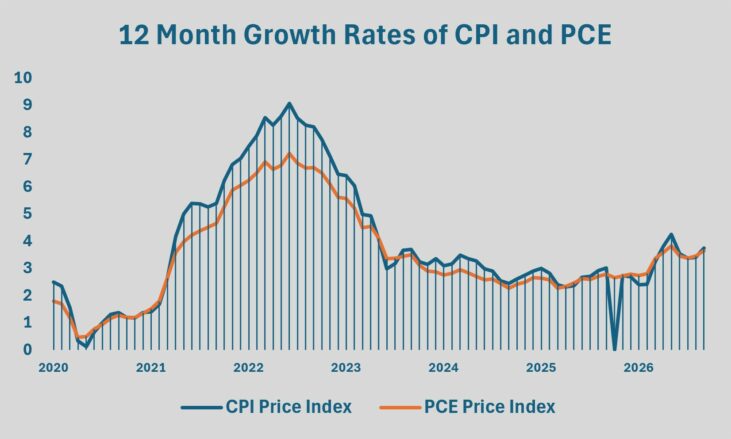 Source: Federal Reserve Bank of Cleveland
The day after the FOMC policy meeting concluded (and five days before the mid-term elections), the Bureau of Economic Analysis (BEA) released its advance estimate of third quarter 2026 Gross Domestic Product (GDP). Real GDP was up 3.4% annually! Not only is this a significant improvement over second quarter’s 2.2% annual growth, it marked the fastest growth in a year. It even exceeded the 3.1% economists had expected.
Government spending played a part in the increase, but primary contributors were consumer spending and investments (particularly in AI). Imports and exports were both in negative territory, or the increase may have been even greater. This news was supportive of the committee’s decision to leave rates unchanged for now.
On another note, we would like to congratulate the Milwaukee Brewers on their decisive win over the Tampa Bay Rays in their first ever Major League Baseball Championship! We likened this year’s World Series to two community banks battling out to determine the best-of-the-best. They were two small market teams putting on a world class show with a limited budget.
Just as the Brewers were about to clinch the series, 4-Star Bank of America, Charlotte, NC (3510) announced it had just opened five new branch offices in the Badger State (its first in the state) and plans on opening 14 more by 2030. Even a big bank like BofA (the Nation’s second largest by assets) understands that “when buying a home, starting a business or planning for retirement, they (clients) want to sit down with someone they trust” – Brian Moynihan, CEO of BofA.