
During the first three quarters of 2026, nine new banks were launched, including eight community banks.
It is important to understand that while some fintech companies operate as FDIC-insured banks, others simply provide banking services through technology platforms.
Consumers should remain mindful of FDIC insurance coverage as fintechs and trust banks continue to reshape the banking landscape, as many trust banks do not have FDIC-deposit insurance.
JRN by Bauer 43:42, October 28, 2026
New Community Banks Reinforce the Value of Local Banking
Back in November of 2020, we described a new brand of “nontraditional banks” that was popping up as many Fintechs and special-purpose banks were seeking Trust Bank Charters. Unlike traditional banks, many Trust Banks do NOT carry FDIC deposit insurance. To keep your deposits safe, we suggested you verify insurance status on either bauerfinancial.com or fdic.gov.
That recommendation still stands. There are countless fintechs that offer apps and other front-end tech that make them look and feel like real online banks. Then there are other fintechs that ARE actual FDIC-insured banks. While we reported on these institutions a few weeks ago (JRN 43:35), today we are very pleased to report on new (de novo) community banks.
New readers may wonder why BauerFinancial is such an avid supporter of community banks. It’s because community banks care about their community and the people around them just as much as they care about profits. Unlike big banks that are beholden to shareholders whose interest is often restricted to how much they receive in dividend payments, community banks exist to benefit the community. We appreciate that.
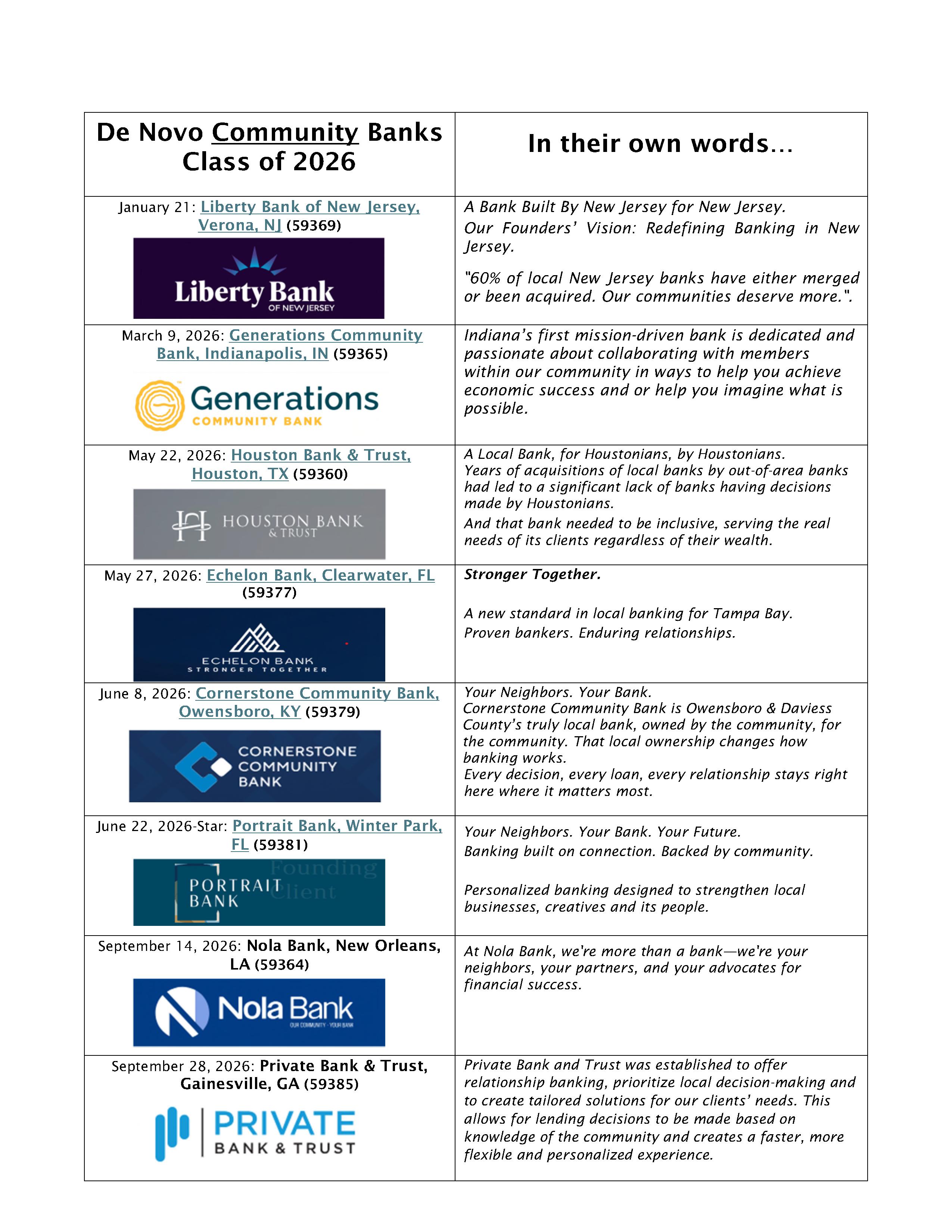
In the first three quarters of 2026, nine new banks opened for business. Eight of them are community banks. They follow with a quote from their respective websites that explains why they believe in the community bank model.
(The non-community de novo bank was Erebor Bank, NA, Columbus, OH (59378). It opened on February 6, 2026 to fill the void left behind by the failure of Silicon Valley Bank. Its plan is to provide crypto-related products to Tech and AI companies, as well as other “innovative” entities and payment servicers for foreign banks. It is not a community bank at all, but a bank of the ultra-wealthy (JRN 43:27).)
As of this writing, we are just one de novo short of tying with 2024 & 2025 combined. In 2024, six de novos opened; in 2025 there were only four. Fifteen others have received preliminary approval for FDIC deposit insurance, so we think there is a very good chance we will end the year with at least 11 de novos. However, most of those pending are NOT community banks. In fact, six are Utah industrial bank applicants.
So, while we are heartened to see nine de novos in nine months, we know it is nowhere near enough to make up for the well over 100 that were lost in that time.
One of the “wanna-be” de novos, Ford Credit Bank, Salt Lake City, UT, has been trying to open an Industrial Bank in Utah since 2006 (JRN 39:31). Persistence may pay off this time around. Ford Credit Bank received conditional approval for FDIC deposit insurance and approval from the Utah Division of Financial Institutions on January 22, 2026.
The conditions set forth by the FDIC include initial paid-in capital of at least $1.5 billion and a tier 1 capital ratio of at least 15%. The FDIC also stipulated that prior to the deposit insurance effective date, The Bank, Ford Motor Credit Company, Ford Holdings LLC and Ford Motor Company must enter into a Capital and Liquidity Maintenance Agreement with the FDIC.
Remember, the primary difference of an Industrial Bank is that it can be owned by a company that is permitted to engage in non-financial activities that are beyond the supervision of Federal Banking Regulators. This distinction means that federal regulators have limited financial information on the parent. That’s why these requirements are necessary. Whether Ford forges ahead and completes the stringent de novo process or not, only time will tell.