
The average 30-year mortgage rate has climbed to 7.40%, hovering near recent highs and making homeownership increasingly unaffordable for many buyers.
As a result, homebuyer demand has weakened to the point where sellers now outnumber buyers by 63%, the largest imbalance in at least 13 years.
Home sales have also declined 4.3% year over year, fueling a continued build-up of unsold inventory that has been growing for the past 34 months.
While home prices have remained relatively stable, elevated borrowing costs continue to be a major obstacle for would-be buyers.
JRN by Bauer 43:41, October 21, 2026
It’s Technically a Home Buyers’ Market, But…
According to Redfin News, a decline in homebuyers has now resulted in a surplus of home sellers; sellers now outnumber buyers by 63%. That’s a number not seen in years. In fact, according to Zillow, September marked the 34th consecutive month of annual gains in “for-sale” inventory; the number of actual home sales year-to-date was down 4.3% from a year earlier (Redfin). Buyers are sitting on the sidelines and for good reason.
While Zillow reports home values haven’t changed much in the past year, the average 30-year mortgage rate (according to FreddieMac) is 7.40%. That’s 1.13% higher than 1 year ago and 4.59% higher than mid-October 2020. Anyone waiting on the sidelines hoping mortgage rates would continue their decent from 2023 levels (7.63%) got a rude awakening. Rates are very near that previous high and they continue to climb.
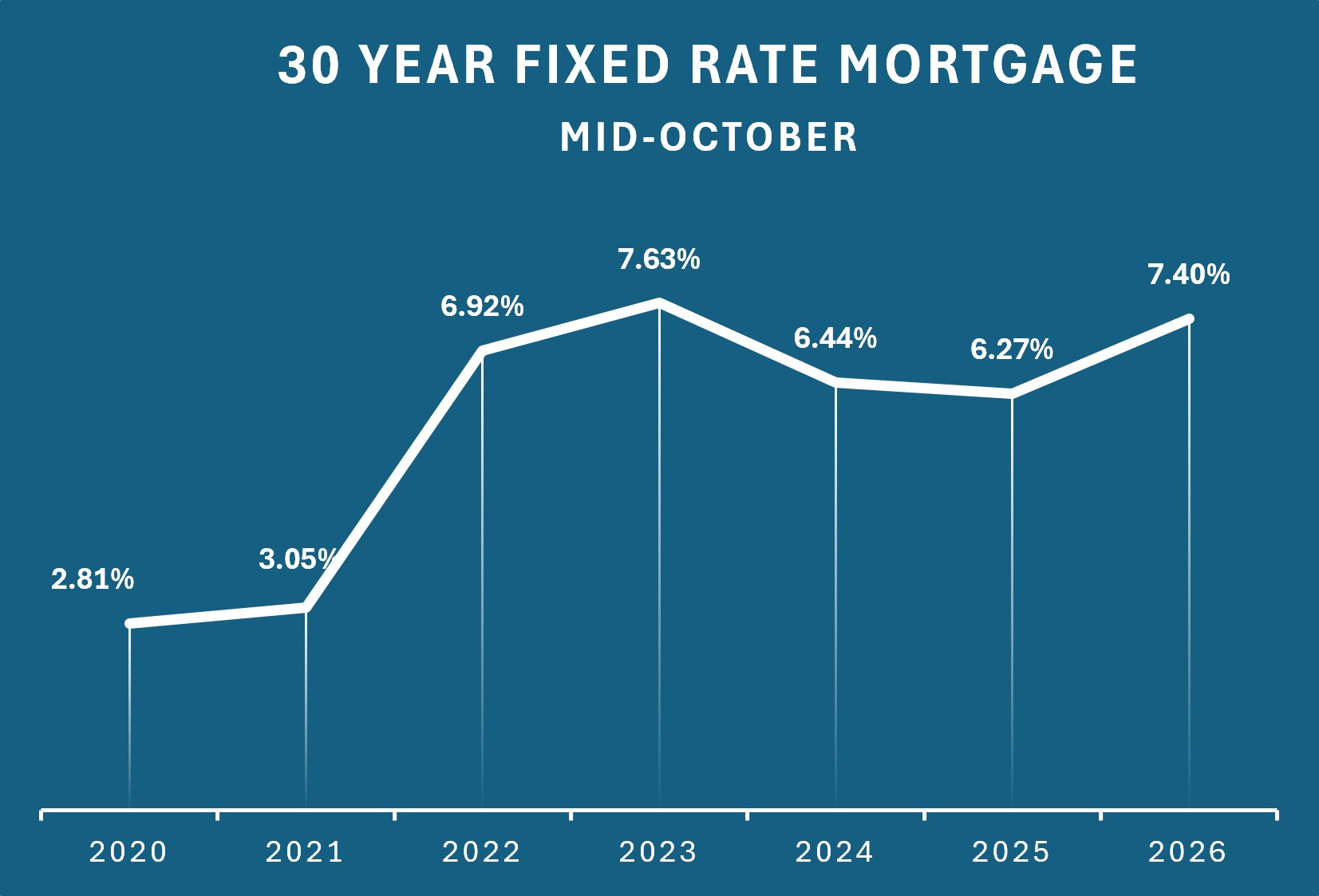
Source: FreddieMac
According to the same Zillow Market Report, a U.S. household earning the median income would have to spend 34.3% of that income on a “typical mortgage payment” versus 26.3% on a “typical rent”. That’s enough in itself to put off buying a home. Now add the findings from the Financial Health Network’s 2026 U.S. Trends Report, which reports that between spring 2025 and spring 2026 American households experienced a widespread drop in financial health.
While the share of “Financially Healthy” U.S. households remained steady at 31% (slightly less than 1/3rd), over the course of the year more than 91% of households remained in the same category. Of those that moved: 16.5 million households moved down a tier whereas only 13.8 million moved up. The three categories are Healthy, Coping and Vulnerable. As a result of this movement, the financially vulnerable portion of our population increased from 15% to 17% last year.
This translates into increased stress as households are losing their ability to pay their bills on time, let alone save money for a mortgage. Managing current debt has become a concern, making the idea of taking on a new mortgage daunting, at best. Five of the eight indicators the Financial Health Network sampled were down over the year, and some are quite disturbing.
For example, according to the report, less than half of U.S. households said they spent less than they made during the previous year. That number went from 49% in 2025 to 47% in 2026. Respondents who paid all their bills on time during the 12-month period dropped from 71% in 2025 to 68% in 2026. Those who are at least “moderately confident” they are on track to meet long-term financial goals dropped from 43% to 41%. It’s no wonder they are not rushing out to buy a new home.
Some banks are even exiting the single-family mortgage market, labeling it is an unprofitable business in the current interest rate environment. 5-Star WaFd Bank, Seattle, WA (28088) along with its merger partner 5-Star EverBank, N.A., Jacksonville, FL (34775) are both in the process of reducing their mortgage loan portfolios. Combined, they cut their single (1-4) family mortgage loan portfolios by nearly 10% in the 12 months ended June 30, 2026. (Holding long-term mortgages at 4% while also paying CD rates of 4% is not a winning strategy.)
Neither WaFd nor EverBank were among the top mortgage lenders even before they began their reductions, but combined, they are among the top 50. The top ten are shown below. These 10 big banks account for 47% of all bank industry single family mortgage loans. They are also all among the top when talking about delinquent mortgage loans in dollars. That is due to the sheer size of their portfolios. Percentagewise, none come close to Everbank’s 5.5% nonperforming rate on single family loans, most of which carry a government guarantee.
The WaFd-EverBank transaction is expected to be completed early next year at which time EverBank will be merged into WaFd, then WaFd will change its name to EverBank.
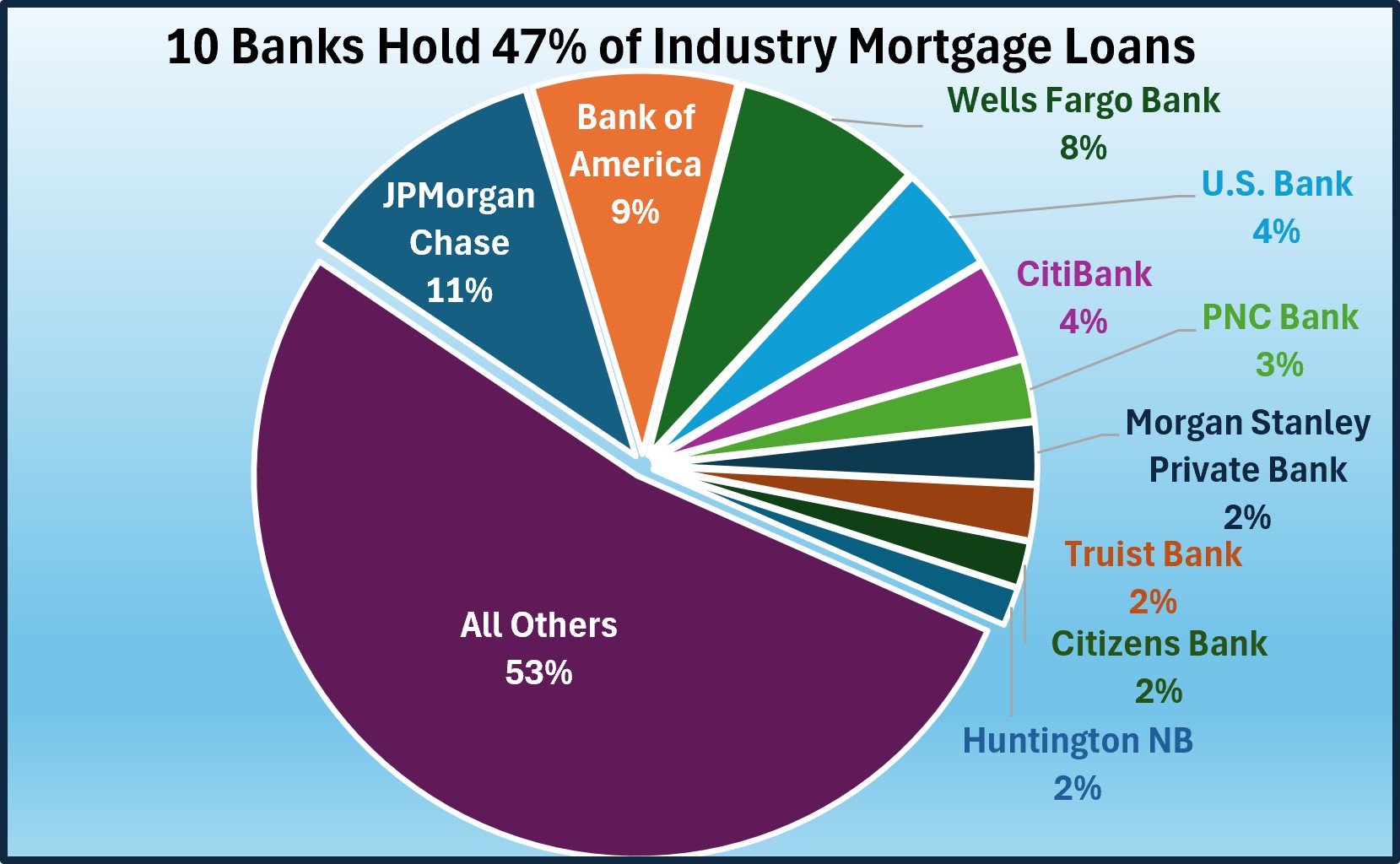
As we were preparing this article, third quarter earnings results began trickling out, including nine of the ten above. We were hoping to find some comments about residential mortgage loans. Instead, common themes included stress from higher borrowing costs and gas prices that are both taking a toll. All said, though, the banks indicate that consumers (thus far) remain resilient. We hope that remains the case.