Texas is emerging as a major financial hub, with a new Texas Stock Exchange launching in Dallas and additional expansions from NYSE and Nasdaq.
Backed by major financial firms and supported by business-friendly policies and no state income tax, Texas is attracting growth in banking and financial activity. It already leads the U.S. in number of banks and branches.
JRN by Bauer 43:23
Texas: America’s New Financial Capital
We suspect that some people in other states might take offense to that statement, but don’t shoot the messenger. We’re just repeating what both Ron Butler, Chairman of the Texas Bankers Association and Texas Governor Greg Abbott, have been saying for a while.
Indeed, a new Texas Stock Exchange gained SEC approval last fall and is set to begin trading in Dallas in July. That’s a big feather in the cap (or Cowboy Hat) for the Lone Star State. The new TXSE has backing from heavy-hitters like J.P. Morgan, Charles Schwab and BlackRock as demand continues to grow.
If that’s not enough, the New York Stock Exchange (NYSE) has also announced plans to launch NYSE Texas, while Nasdaq launched its own Nasdaq Texas in March.
The Nasdaq Texas opening began with the ceremonial ringing of the closing bell at the Alamo in San Antonio on the 190th anniversary of the famous battle. The first bank listed on the Nasdaq Texas was Huntington Bancshares Inc., parent of 5-Star Huntington Bank, Columbus, OH (6560), but it is getting lots of company.
In addition to a very pro-business government, Texas is one of eight states with no income tax, making it a very pro-consumer state as well.
But the question persists. Does that make Texas America’s new financial capital?
Other states have had their own stock exchanges in the past and for a variety of reasons, they all ceased to exist long ago. The New York Stock Exchange is the only exchange that has stood the test of time.
Of course, many other factors have to be considered when determining the “Financial Capital”. We are not forming an opinion here at Bauer, other than to say, in our opinion, most consumers handle their finances close to home, making their home state their own personal financial capital. This did get us thinking, though. And we found some interesting information to consider. We will start with banks.
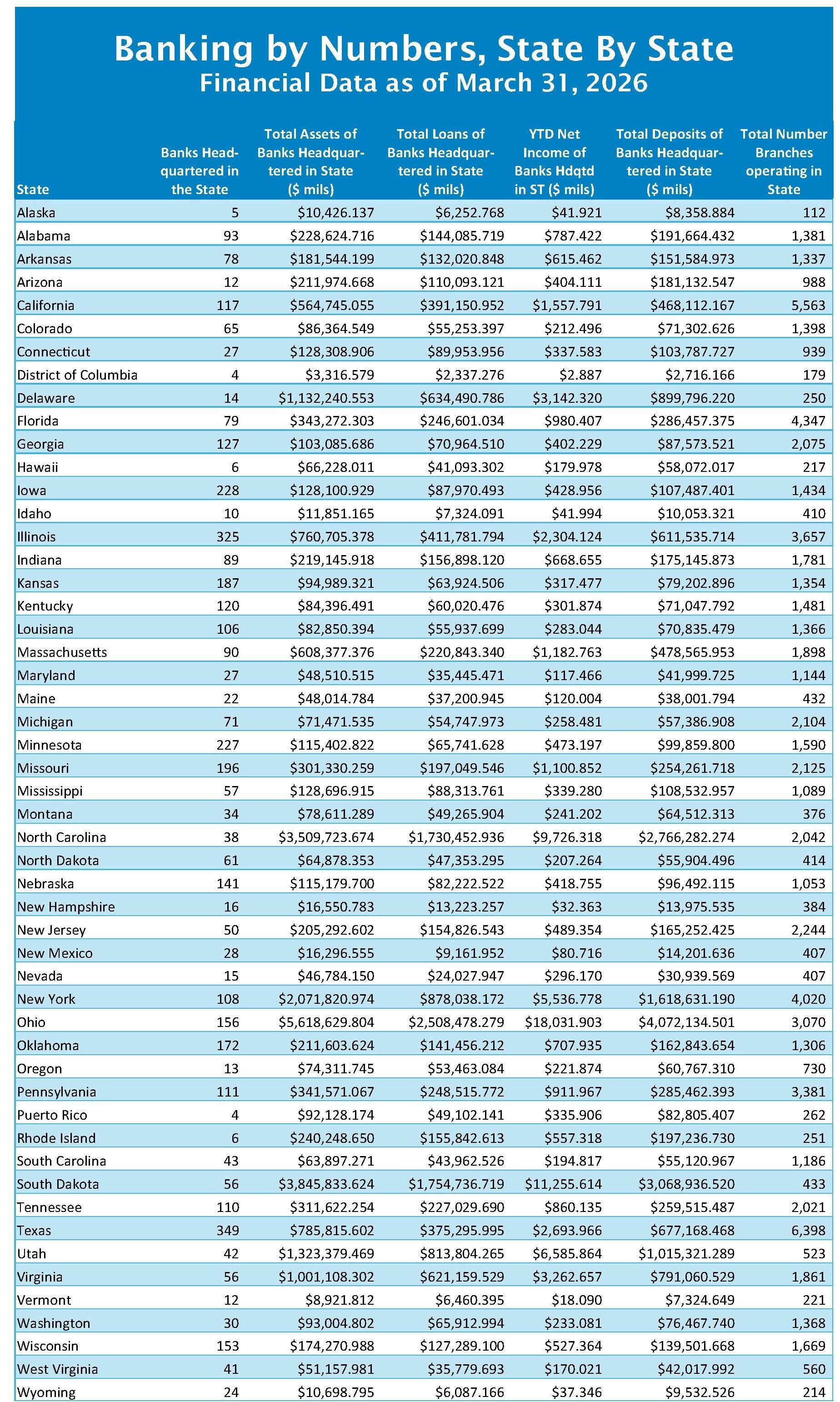
Below, we have listed each of the 50 states as well as the District of Columbia and Puerto Rico along with pertinent bank information for each.
You will notice that Texas is home to the most banks in the United States (349) as well as the most bank branches (6,398). These account for 8.21% and 8.26%, of the nation’s total, respectively.
Texas is a big state, so it is natural it would be near the top. However, California has the largest population, so its numbers should be high as well. Yet, California is home to just 117 banks (2.75% of the total) and 5,563 bank branches (7.18% of the total).
Banks seem to prefer branching in California rather than planting roots there. All other things equal, with about 39.355 million residents or 11.5% of the nation’s total, we would expect it to be home to roughly 11.5% of the nation’s banks. At just 2.75%, it is far from that number.
New York, which has been known as the Financial Capital of the United States for years, has just over 20 million residents (5.85% of the total) and is shrinking. The state is home to just 108 banks (2.54%). Similar to California, banks want the business, so they branch there, but they don’t necessarily want to “live” there.
In fact, banks in both California and New York are deciding to switch from state to federal charters. 5-Star Citizens Business Bank, N.A., Ontario, CA (21716), for example, converted to a national charter in December 2025.
5-Star Jeff Bank, Jefferson, NY (7123) received approval to convert in May but the conversion has not been completed yet. Interestingly, Jeff Bank started out as a national bank but converted to a state charter in 2012. The tides have changed and so has it.
Texas, unlike the other two, is growing… and it has the physical space to continue that growth. That leads us to the chart below. We sourced data from both the U.S. Census Bureau and a Charles Schwab report then added our own bank data and calculated some percentages.
Texas may be loud and proud, but the numbers support it. It may soon have us all talking about Ya’ll Street. Regardless of what state you call home, Bauer has a Statewide Bank Report that provides the current and previous star-ratings along with financial highlights on every bank operating in the state. Order yours now for immediate download.